SaaS solution

Atlas

The management console for Moroccan tutoring centres — students, payments, payroll and compliance in one place

Atlas

Atlas is the management software for tutoring centres built by SWIVIQ. It covers a Moroccan centre's entire day: enrolments, groups and timetables, attendance, cash payments and instalments, WhatsApp reminders to parents, report cards and handouts, library loans, private lessons, expenses, statistics — and human resources too, with payslips compliant with the 2026 finance act and leave computed under Moroccan labour law. What foreign software does not do, Atlas does because it was written here: CNSS (social security), AMO (compulsory health insurance) and income tax live in the code, religious public holidays are computed on the Hijri calendar, Arabic is a first-class language, and paying cash at the front desk is the normal case — not a workaround. Under the hood: 28 modules enabled by subscription, access control down to the individual permission, a timestamped audit trail, a financial fraud-detection engine that scores every action touching money, and a strategic advisor that compares years, forecasts the next one and costs out an expansion. Atlas is designed, hosted and maintained by SWIVIQ.

Key features

  • Students, enrolments, levels, groups, subjects and rooms
  • Timetables, slots, availability and room occupancy
  • Cash payments, instalments, due dates and arrears
  • Automatic WhatsApp reminders to parents, in bulk or one by one
  • Moroccan payslips: CNSS, AMO, income tax, professional allowance, net amount in words
  • Leave under Moroccan law: 1.5 days a month, seniority, Hijri holidays, approval by link
  • Student and teacher absences, justified or not, with reports
  • Report cards, teacher comments and handouts
  • Library: catalogue, loans, returns and subscriptions
  • Private lessons, centre expenses and pro-rata calculation
  • Financial fraud detection: every action touching money is scored and alerted on
  • Timestamped audit trail: who changed what, when, and from where
  • AI advisor: year-on-year comparison, forecast, expansion analysis
  • Polls and educational games delivered over WhatsApp
  • Referrals, tickets, real-time notifications and backups
  • 28 modules enabled by subscription, 10 of them impossible to switch off
Atlas at work

Twelve modules, and a day that stops repeating itself

Atlas does not replace a spreadsheet with an online spreadsheet. It takes the entire day of a Moroccan centre — opening, the front desk, the arrears, the review, month end — and makes every action verifiable. Pick a module to see what it does, then look below to see what it puts on screen.

28catalogued modulesThe catalogue lives in the code: a module exists only if there is code behind it.
10impossible to disableCore modules cannot be cut by anyone — no configuration mistake shuts you out of your own software.
4contract regimesPermanent, fixed-term, ANAPEC exempt and hourly-paid at 17 % final withholding — the regime that actually applies to teachers.
6income tax bands encodedThe Moroccan scale with deductible amounts, fully editable: a finance act changes every year.
30 %discount = alertThe financial engine scores every action touching money: a 30 % reduction is suspicious, 50 % critical.
2checks per callEvery permission is verified in the browser AND on the server: a check that exists only in the browser hides a menu, it protects nothing.
Baies actives12
En fonctionnement

A day at the centre, from opening to month end

Five moments, five screens. This is the real day of a centre in Rabat: students arrive, the front desk takes cash, arrears are chased on WhatsApp, actions touching money are reviewed, and the month ends with payslips foreign software cannot issue.

8:30 am — attendance, before the first parent asks

Groups arrive, attendance is entered. Justified or unjustified: the distinction is made at source, because that is what matters when a parent calls. In the same movement the dashboard updates — active students, absences this month, payment arrears, today's revenue.

Dashboard — Centre Atlas
184Active students
167Present this morning
23Absences this month
9Payment arrears
Attendance this month91 %
Room occupancy76 %
Instalments collected68 %
Benchmark

Against the management software of the world

The United Kingdom, Canada and the United States publish excellent tutoring management software. None of it was written for a Moroccan employer. The grid below is that of a centre manager in Morocco — twelve weekly obligations, several of them legal. On this grid, and this one only, Atlas comes first.

Atlas Morocco24/241er
TutorCruncher United Kingdom7/242e
Teachworks Canada7/242e
TutorBird Canada3/246e
Pike13 United States4/245e
Spreadsheet + WhatsApp the real competitor5/244e
What a Moroccan centre manager has to do — comparatif fonctionnel face à 5 éditeurs
What a Moroccan centre manager has to doAtlasMoroccoTutorCruncherUnited KingdomTeachworksCanadaTutorBirdCanadaPike13United StatesSpreadsheet + WhatsAppthe real competitor
Moroccan payslip (CNSS, AMO, income tax) A centre employs teachers: payroll is monthly and the law is local.
Leave under Moroccan labour law 1.5 days a month, seniority, article 274, 98-day maternity, Hijri holidays.
Cash payments and instalments Most payments are made at the desk, in cash, in several parts.
WhatsApp reminders to parents In Morocco an email goes unread; a WhatsApp message is read within the hour.
Fraud detection on financial actions The risk of a cash-taking centre is not an outage, it is the quiet discount.
Timestamped audit trail with author Knowing who changed what, and when, without having to ask.
Per-permission rights, checked on both sides Four fixed roles force a choice between opening too much and closing too much.
Multi-centre with isolated data A group shares a tool without sharing its data or its rights.
Library, handouts and book loans A Moroccan centre lends books and hands out printed material; that is daily reality.
Arabic, right-to-left interface Part of the staff and of the parents read Arabic before French.
Prices published, no sales call required Answering "how much does it cost" beats a contact form.
Core modules impossible to disable No configuration mistake — commercial ones included — should shut you out of your own software.
Couvert en standard Partiel — contournement, extension ou paramétrage Absent

Méthode. This comparison is built from the features each vendor publishes on its own site at the date shown. "Partial" means the function exists but requires a workaround, a paid add-on or manual configuration. The criteria are those of a Moroccan tutoring centre: on a different grid — card billing, UK compliance, video conferencing integration — several of these vendors would come ahead of us, and we say so. Comparatif arrêté au 23 August 2026.

Deep dive

How it is built

Twenty-eight modules, and ten nobody can switch off

Atlas is sold by subscription, so some modules open and close. The catalogue lives in the code, versioned and reviewed in diffs: a module exists only if there is code behind it. It is reconciled on every start — a new code is inserted, an existing one is never overwritten (labels the administrator edited survive), a code that disappears is deactivated rather than deleted, so the permissions referencing it do not break.

Ten modules are marked core: students, levels, subjects, payments, teachers, timetables, absences, rooms, settings, permissions. They are in every plan and nobody can cut them. That is the anti-lockout safeguard: no configuration mistake, no unpaid invoice, no support blunder can shut a customer out of their own software.

One last detail, and it matters: adding a module to the catalogue without declaring it in the routing table makes the server refuse to start. That is deliberate. A half-wired module is an open door onto data a subscription has not paid for.

RequêtePremier résultatSource
Starter plan 100 students, 5 accounts, core modules 199 MADplans.config
Pro plan 300 students, 15 accounts, +6 modules 399 MADplans.config
Premium plan Unlimited, every module 699 MADplans.config
During the trial Enrolments opened on top of the plan +1TRIAL_MODULES
  • 28 catalogued modules across 6 families
  • 10 core modules present in every plan and impossible to disable
  • Catalogue in code, seeded and reconciled on every start
  • A withdrawn module is deactivated, never deleted — the permissions citing it survive
  • Catalogue and routing table out of sync = the server refuses to start
  • Per-plan quotas on active students and user accounts
The Moroccan payslip, finance-act rates included

No foreign tutoring-management software issues a Moroccan payslip. Yet it is the monthly obligation of any centre employing teachers, and the one most expensively outsourced.

Atlas encodes the rates in force: employee CNSS at 4.48 % capped at 6,000 dirhams, AMO at 2.26 % uncapped, an itemised employer share, a professional allowance of 35 % up to 6,500 dirhams of gross pay and 25 % beyond with their respective ceilings, a six-band income tax scale with its deductible amounts, and a family allowance of 50 dirhams per dependant, capped at six. Everything stays editable — including the tax bands — because a finance act changes every year, and a hard-coded rate turns a scale change into a software release.

Four contract regimes coexist: permanent and fixed-term contracts on the full regime, ANAPEC contracts with no deductions at all during the integration exemption, and hourly-paid teachers on a 17 % final withholding without CNSS — the regime that actually applies to substitute teachers.

A validated payslip is frozen: the full detail of the calculation is stored at issue time, and the PDF re-reads that detail instead of recomputing. A payslip whose amount changes six months later, because a rate moved in between, is not a payslip — it is a dispute.

RequêtePremier résultatSource
Employee CNSS 4.48 % — capped at 6,000 MAD 2026 actpayroll_settings
AMO 2.26 % — uncapped 2026 actpayroll_settings
ANAPEC contract No deductions — 24-month exemption 0 %regime
Hourly-paid teacher Final withholding, no CNSS 17 %regime
  • CNSS 4.48 % capped at 6,000 MAD, AMO 2.26 % uncapped, itemised employer share
  • Professional allowance of 35 % or 25 % depending on gross pay, with ceilings
  • Six-band income tax with deductible amounts, family allowance 50 MAD × 6 maximum
  • Four regimes: permanent, fixed-term, ANAPEC exempt, hourly-paid at 17 % final withholding
  • Every rate editable, tax bands included
  • Validated payslip = frozen calculation; the PDF re-reads, it never recomputes
  • Net amount in words, and the leave balance carried onto the payslip

Leave, computed under Moroccan law and never stored

The annual entitlement is one and a half days per month worked, increased by another day and a half for every five years of seniority, capped at thirty days. Atlas computes it on the fly, at every lookup. No counter is stored: only the previous year's carry-over and manual adjustments are.

That choice is not a technical affectation. A stored counter drifts — a corrected hire date, a cancelled leave, an adjustment, and the displayed balance stops matching the real entitlement without anyone noticing. Recomputed, it is correct by construction.

The leave types are those of Moroccan law and practice: annual, CNSS sick leave, in-house paid sick days, article 274 absences (marriage, birth, bereavement), 98 days of maternity leave, hajj, unpaid leave. Religious holidays are estimated on a tabular Hijri calendar, accurate to within a day, and flagged as estimated until the administration confirms the date — uncertainty is shown rather than hidden.

Finally, a request is approved from a link received by email or WhatsApp, without logging in: a single-use token, purged the moment a decision is made. A director who has to open a piece of software to approve three days of leave does not approve them, they call back later.

  • 1.5 days per month, +1.5 days per five-year band, capped at 30 days
  • Balance recomputed at every lookup — no counter that can drift
  • Types seeded per centre: annual, CNSS and in-house sick leave, article 274, 98-day maternity, hajj, unpaid
  • Religious holidays estimated on the Hijri calendar, flagged as such until confirmed
  • Approval via a single-use link, no login, purged after the decision
  • The balance flows automatically onto the payslip

Every action touching money is scored, and some raise an alert

In a centre taking cash, the risk is not a system outage: it is the quietly granted discount, the deleted payment, the price lowered after the fact. Atlas ships an engine that watches every financial action and assigns it a risk profile.

The thresholds are explicit and in the code: a 30 % price reduction is suspicious, 50 % is critical; more than ten actions in five minutes flags abnormal entry; amounts above 5,000 dirhams warrant attention, above 10,000 they are critical; an operation between 10 pm and 6 am is flagged as out of hours; five deletions a day or fifteen a week raise an alert, as does 50,000 dirhams of cumulative reductions over seven days.

In parallel, the audit trail keeps the full history of changes with author and timestamp. The difference between the two is sharp: the audit trail answers "who did what", the financial engine answers "is this worth looking at now". A centre has no time to read a log; it needs the three lines worth a question pointed out to it.

RequêtePremier résultatSource
55 % discount on an instalment Critical alert, profile downgraded CRITRISK_CONFIG
12 changes in 4 minutes Abnormal velocity flagged WARNVELOCITY
Payment of 12,000 MAD Critical amount — review requested CRITAMOUNT
6th deletion of the day Daily cap exceeded ALERTMAX_DELETIONS
  • A per-user risk profile, built from their financial actions
  • 30 % reduction suspicious, 50 % critical
  • More than 10 actions in 5 minutes: abnormal entry flagged
  • Operations between 10 pm and 6 am flagged as out of hours
  • Daily and weekly caps on deletions and reductions
  • A timestamped audit trail with author, running alongside the alerts

Rights are set per permission, not per role

A centre's software is used by the director, the front-desk staff, the teachers, sometimes an accountant. Giving them four fixed roles means choosing between opening too much and closing too much.

In Atlas, the source of truth is the individual permission: tables of roles, permissions and grants, all scoped to the centre, adjustable from a dedicated screen. Legacy role letters no longer govern access — with one deliberate exception, the director, who keeps full access on both the browser and the server side.

Verification happens on both sides: the browser's router reads the permission each screen requires, and the server re-checks it on all of its routes. That is the only honest configuration — a check that exists only in the browser protects nothing, it hides a menu.

A handful of routes stay open, deliberately and on the record: Meta's WhatsApp webhook, verified by token; the public site's read-only endpoints; the student portal, protected by a student token; and the super-administration routes, protected by a dedicated key.

  • Roles, permissions and grants per centre, adjustable from the console
  • Checks on the browser AND the server, on every route
  • The director keeps full access, explicitly and on both sides
  • Each screen declares the permission it requires
  • The few token-less routes are listed and protected otherwise
  • Each centre's data isolated by automatic scoping

WhatsApp, because email in Morocco goes unread

Foreign software chases parents by email. In Morocco a parent's email address is neither read nor always known; their WhatsApp is. Atlas makes it a first-class channel, not an optional integration.

The centre sends an arrears reminder to one parent or a whole list, confirms a payment, welcomes a new student, attaches a file, checks a number exists before writing to it, and works from message templates instead of retyping. Sends go through a queue and failures are kept — a message lost without a trace is worse than a message not sent.

On top of that, something no competitor offers: polls and educational games delivered over WhatsApp, with their results and statistics. A centre that keeps its parent group alive keeps its families.

  • Arrears reminders one by one or in bulk, straight from the overdue list
  • Automatic payment confirmations and welcome messages
  • Message templates, attachments, number verification before sending
  • A queue and retained failures — no send lost without a trace
  • Polls and educational games on WhatsApp, with results and statistics
  • Payment receipts rendered as images, readable directly in the conversation

An advisor that actually counts, not a polite summary

Atlas ships a strategic advisor: it compares school years, projects the next one, costs out an expansion, produces a report and answers questions asked in plain language.

What sets it apart from a decorative assistant is that it counts properly. Headcounts are established from payments in the period, not from an "active" checkbox nobody ever unticks. Revenue only counts statuses actually collected. Teacher cost is reconstructed from timetabled hours multiplied by the hourly rate, plus monthly retainers. Retention is the number of students who paid in both years over the previous year's total; churned students are those who paid last year and not this one.

These definitions are written into the code because they are the whole difference between a flattering dashboard and a useful one. On the infrastructure side, several AI providers are wired in with key rotation, automatic fallback, caching and quota monitoring: the advisor does not go down because one provider hiccuped.

  • Year comparison, next-year forecast, expansion analysis, strategic report
  • Headcounts based on payments in the period, not an "active" flag
  • Teacher cost reconstructed from timetabled hours and retainers
  • Retention and churn defined explicitly, on a September-to-August school year
  • Several AI providers, key rotation and automatic fallback
  • Caching and quota monitoring: the service holds when a provider drops

What a Moroccan centre actually does with its days

The rest of the product comes from what generic software ignores, never having watched a Moroccan centre at work.

A centre lends books: there is a catalogue, loans, returns and subscriptions. It hands out printed material: it is assigned, tracked, and parents find it in their portal. It runs private lessons alongside groups, with their own economics. It pays expenses — rent, electricity, supplies — that have to be set against income to know whether a group is profitable. It enrols students mid-year, so amounts are pro-rated over the days actually owed. It runs referrals. It manages rooms that cannot host two groups at the same hour.

Each of these is a module, with its permissions, its screen and its place in the statistics. Added up, they are what makes a centre close its spreadsheet.

  • Library: catalogue, loans, returns, subscriptions
  • Handouts assigned and visible to parents
  • Private lessons tracked separately, with their earnings
  • Centre expenses and per-group profitability
  • Pro-rata calculation for mid-year enrolments
  • Referrals, tickets, real-time notifications, on-demand backups
  • Rooms, capacities and occupancy conflict detection
Gallery

The product story in pictures

Scroll down: each visual tells a chapter of the product.

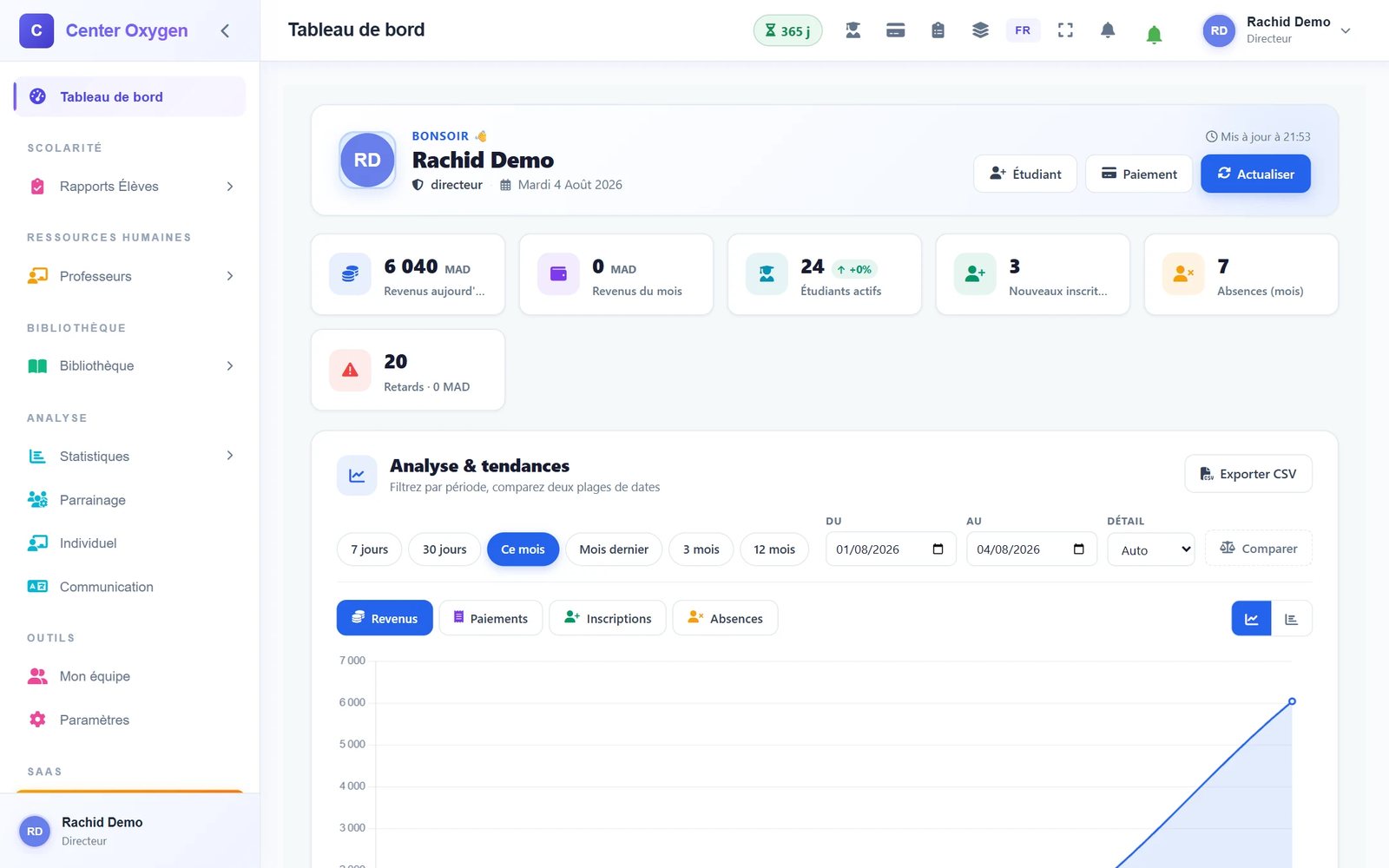
The dashboard, in the centre's own colours
Scene 01 / 09

The dashboard, in the centre's own colours

Daily and monthly revenue, active students, new enrolments, absences, payment arrears — then trends over the chosen period. The console carries the centre's brand, not ours.

Students
Scene 02 / 09

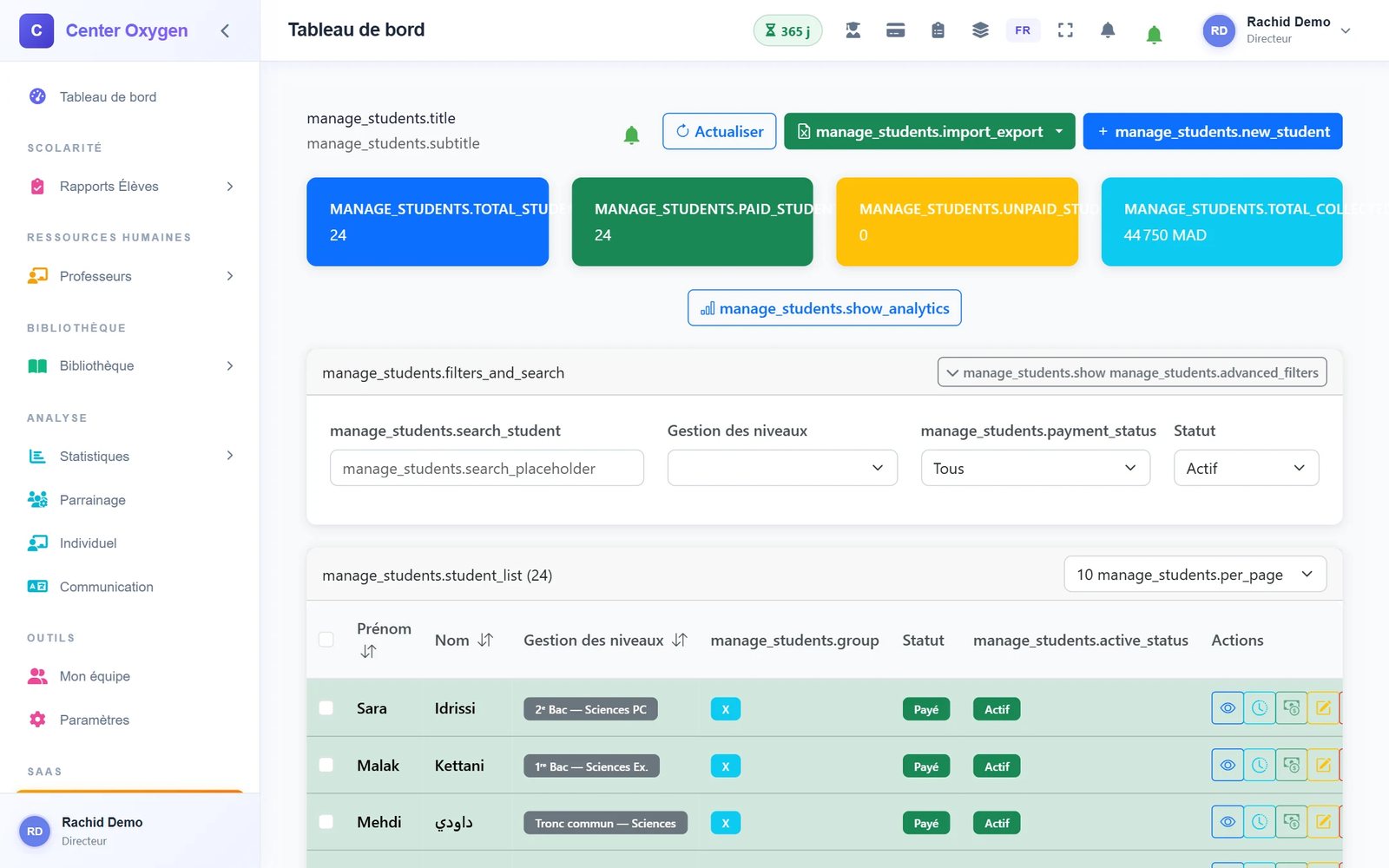
Students

Profiles, levels, groups, subjects and assignments. This is the core module: present in every plan, it cannot be disabled by anyone.

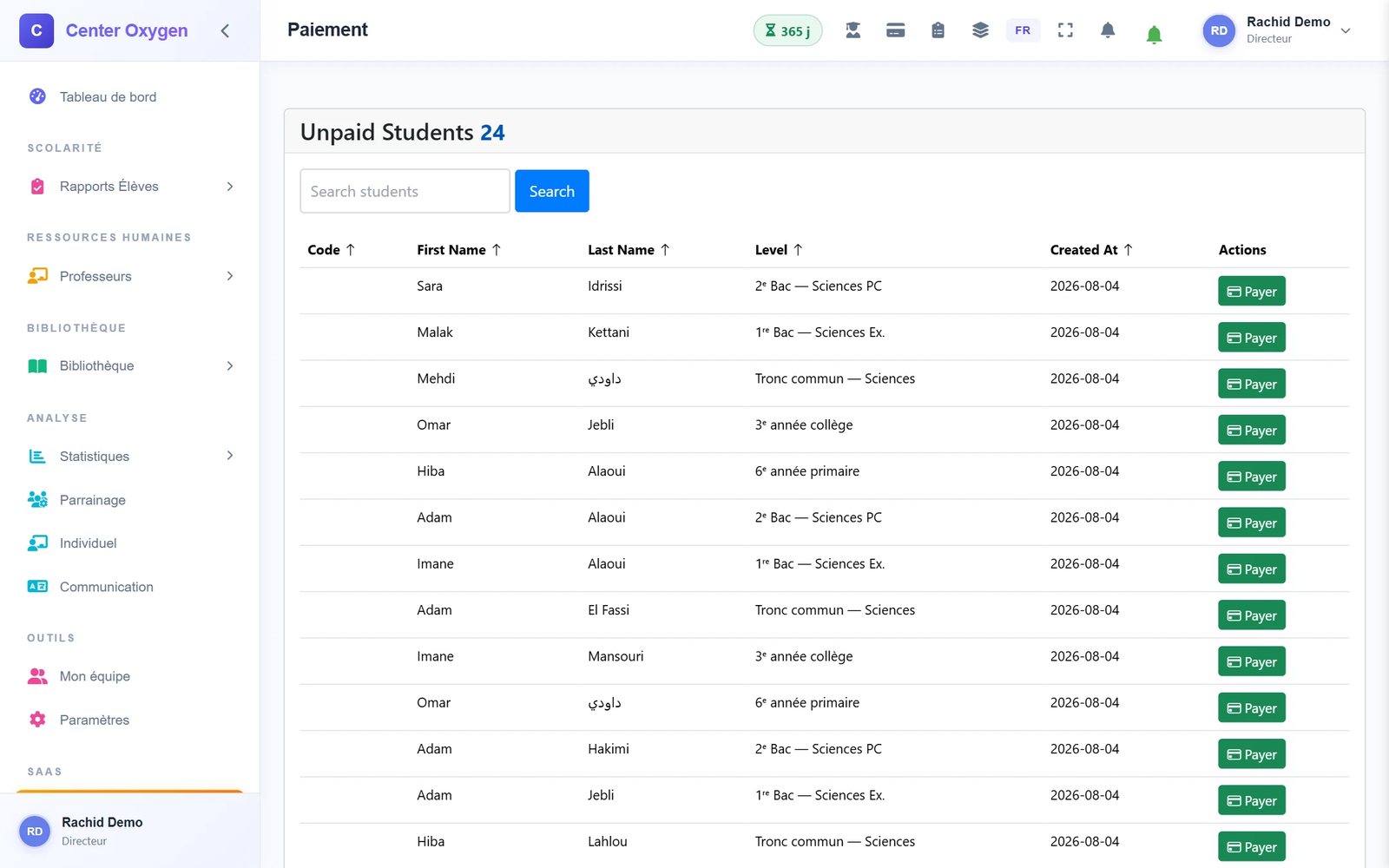
Arrears, and the reminder in one gesture
Scene 03 / 09

Arrears, and the reminder in one gesture

The overdue list turns into a WhatsApp campaign — one by one or in bulk. This is the screen that pays for the subscription in the first month.

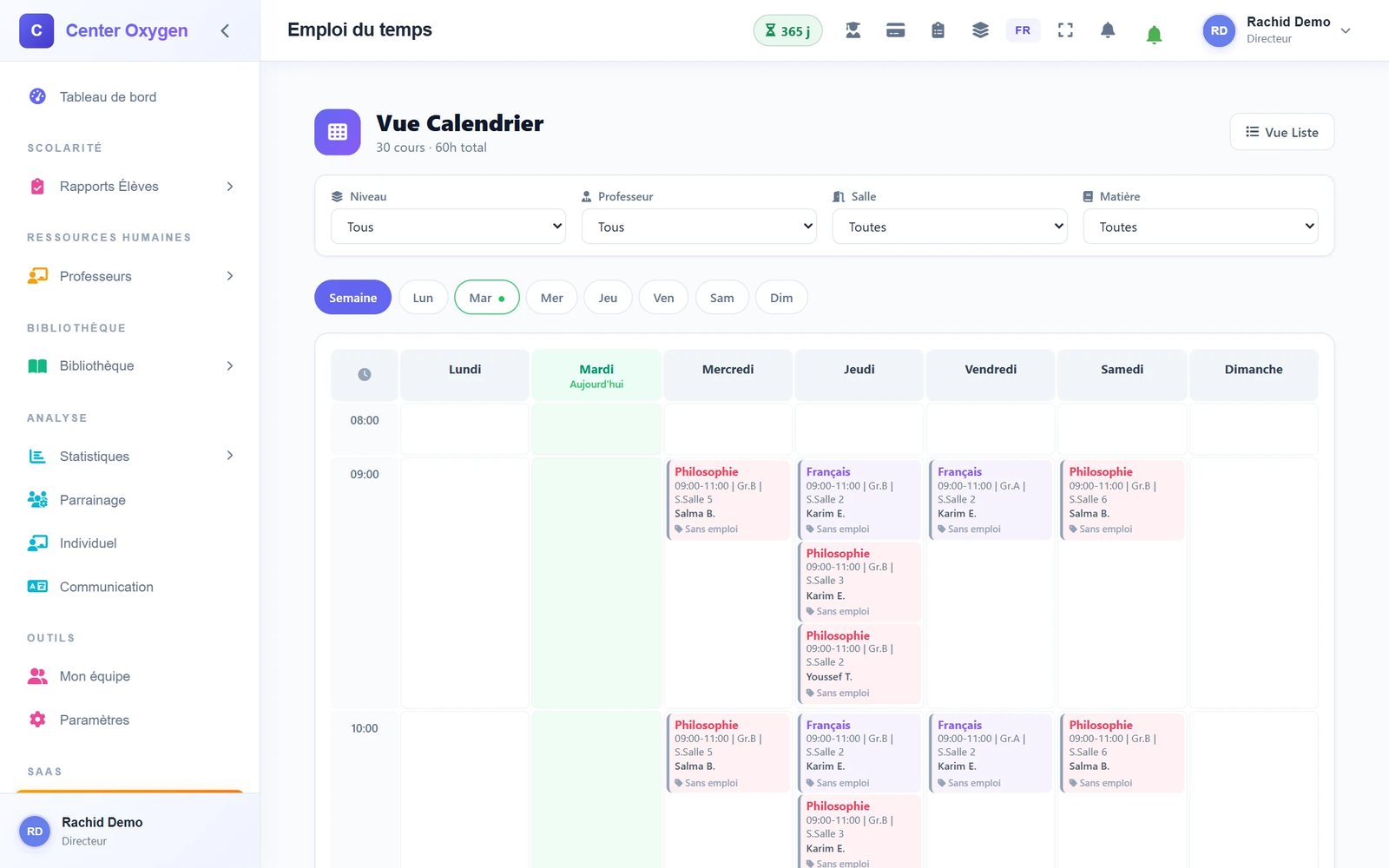
Timetables
Scene 04 / 09

Timetables

Slots, groups, teachers and rooms. Two groups cannot occupy the same room at the same hour.

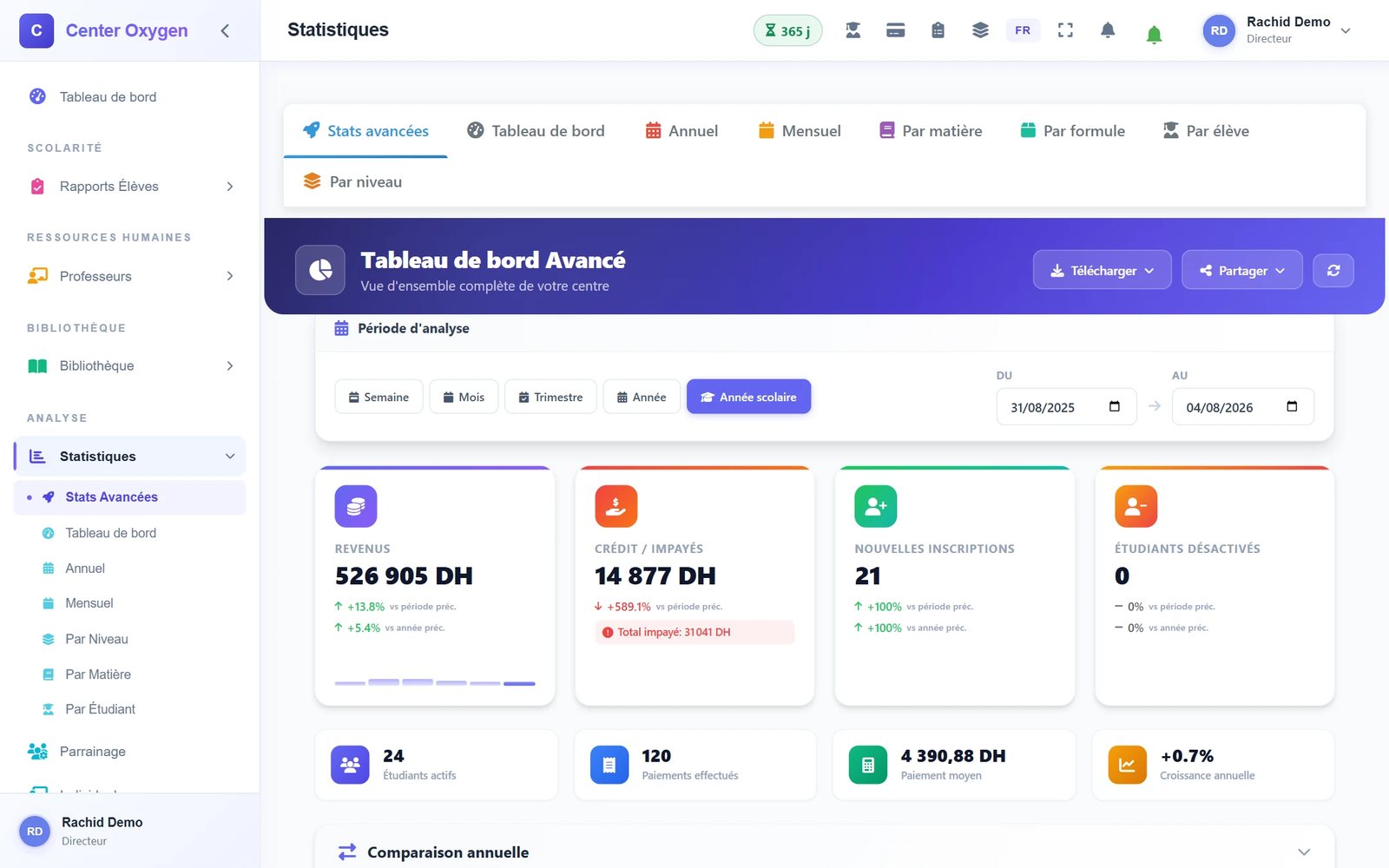
Advanced statistics
Scene 05 / 09

Advanced statistics

Revenue, headcount, attendance and per-group profitability, over the real school year — September to August, not January to December.

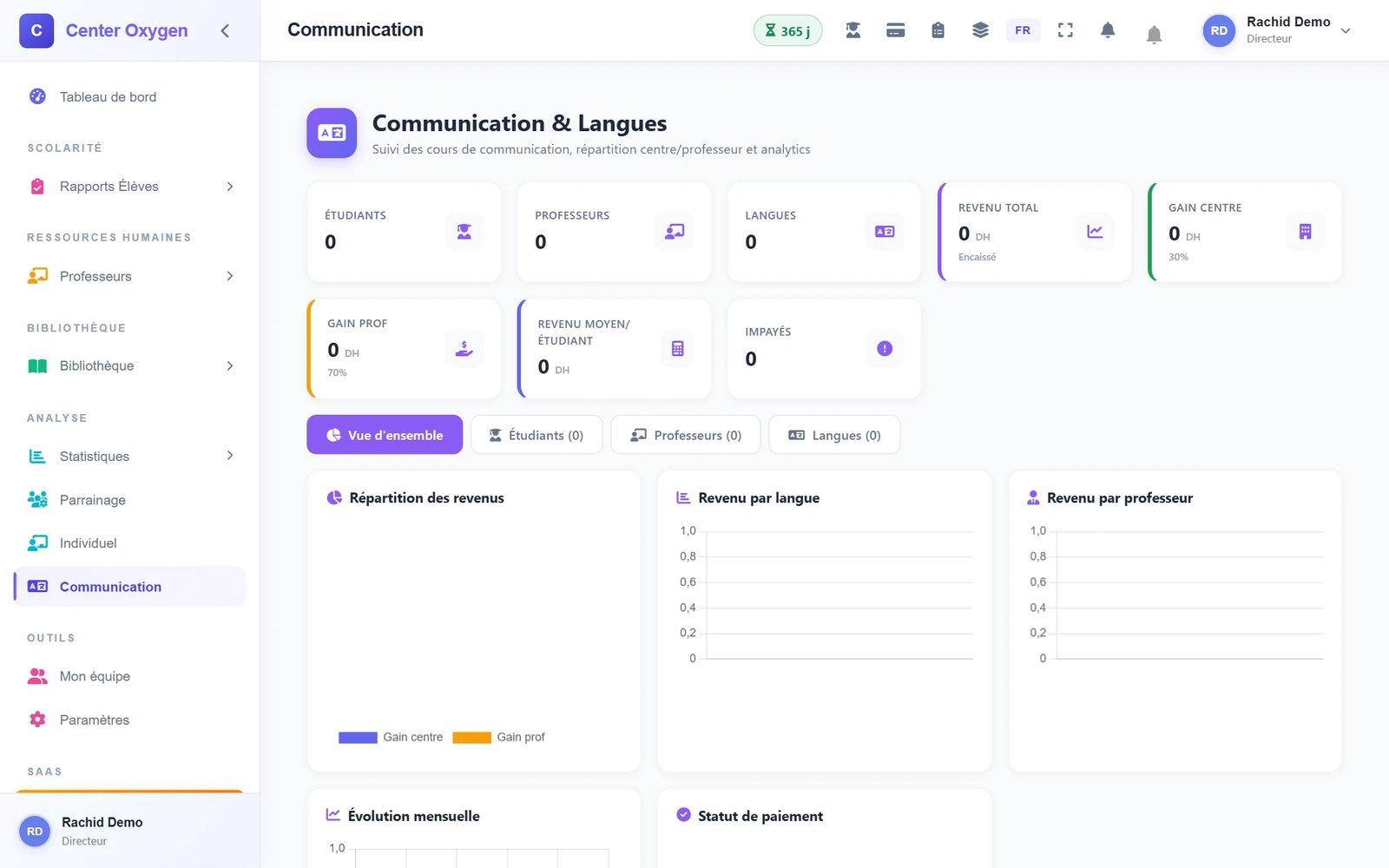
Communication campaigns
Scene 06 / 09

Communication campaigns

Message templates, bulk sends and history. Failures are kept: a message lost without a trace is worse than a message not sent.

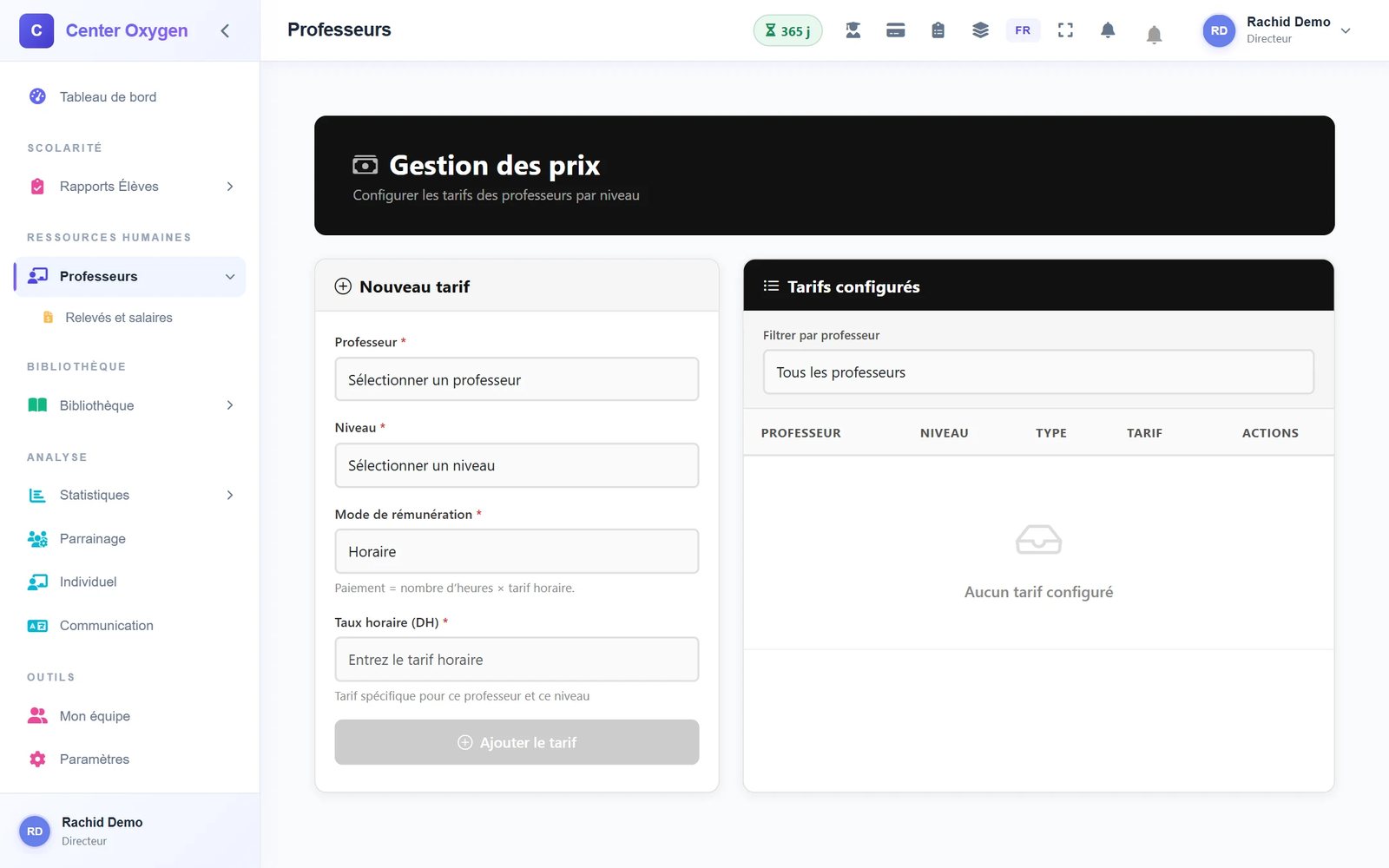
Teacher pay
Scene 07 / 09

Teacher pay

Hourly rates, monthly retainers and timetabled hours — the raw material the strategic advisor uses to reconstruct teacher cost.

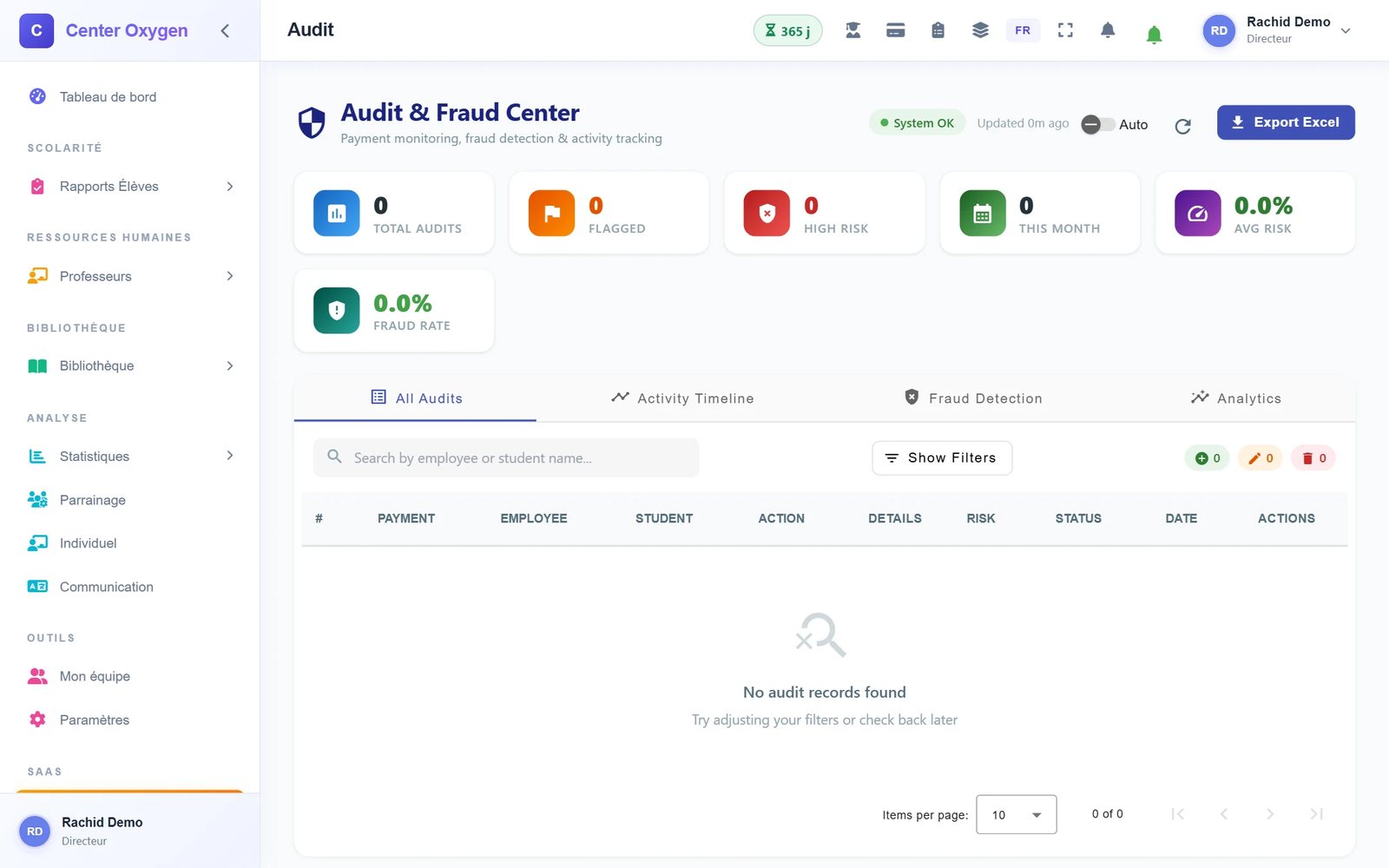
The audit trail
Scene 08 / 09

The audit trail

Who changed what, and when. Alongside it, the financial engine answers the other question: is this worth looking at now.

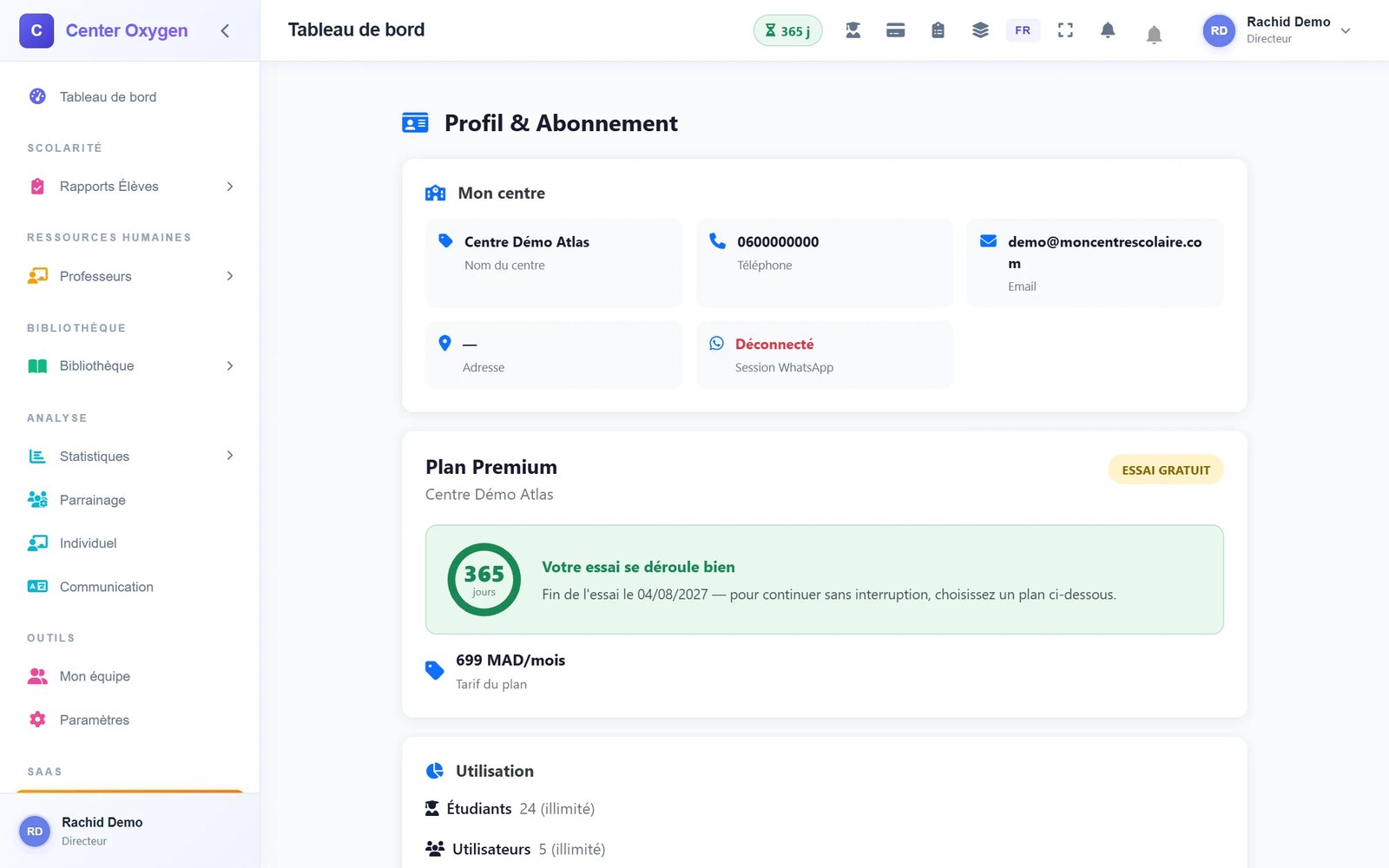
The centre's subscription
Scene 09 / 09

The centre's subscription

Plan, quotas and enabled modules. Ten modules stay active whatever happens: no configuration mistake shuts a customer out of their own software.

Gallery

Starter

199MAD/ month

For a centre starting out — 100 active students, 5 accounts

  • The 10 core modules, impossible to disable
  • Students, levels, groups, subjects and rooms
  • Timetables and absences
  • Payments, instalments and due dates
  • Teachers and pay
  • Roles and individual permissions
  • 100 active students · 5 user accounts

Premium

699MAD/ month

No limits — all 28 modules, unlimited students and accounts

  • Everything in Pro
  • Moroccan payslips (CNSS, AMO, income tax)
  • Leave under Moroccan labour law
  • Strategic advisor and forecasts
  • WhatsApp: reminders, polls and educational games
  • Timestamped audit trail
  • Report cards, handouts, private lessons
  • Referrals, tickets, backups, integrations
  • Unlimited students and accounts
Questions fréquentes

Ce qu'on nous demande avant de choisir Atlas

Atlas or Atlas App — which one do I need?

Atlas is the internal console: students, timetables, payments, payroll, leave, statistics — what your team uses all day. Atlas App is the public face: teacher search, parent portal, baccalaureate tools, applications. Most centres take both, because the public platform brings families in and the console runs them. They can also be bought separately.

How much does Atlas cost?

Three plans: Starter at 199 MAD a month (100 active students, 5 accounts, the 10 core modules), Pro at 399 MAD (300 students, 15 accounts, plus expenses, statistics, library, enrolments, communication and financial tracking), Premium at 699 MAD (unlimited students and accounts, every module). During the trial, the Enrolments module is opened on top of the chosen plan — it is the first thing a centre discovering the tool wants to do.

Is the payslip genuinely compliant?

The encoded rates are those in force: employee CNSS 4.48 % capped at 6,000 MAD, AMO 2.26 % uncapped, an itemised employer share, a professional allowance of 35 % or 25 % depending on gross pay, a six-band income tax scale with deductible amounts, and a family allowance. Four regimes are handled, including ANAPEC exemption and hourly-paid teachers at 17 % final withholding. Every rate is editable, tax bands included, because a finance act changes every year.

What happens if I stop paying?

The ten core modules — students, payments, teachers, timetables, absences, levels, subjects, rooms, settings, permissions — cannot be disabled by any mechanism, commercial ones included. Your data stays accessible and exportable. This is an architectural decision, not a marketing promise: the code refuses to cut those modules.

How does Atlas detect fraud?

Every financial action is recorded and scored. A 30 % price reduction is marked suspicious, 50 % critical. More than ten actions in five minutes flags abnormal entry. Amounts above 5,000 MAD warrant attention, above 10,000 MAD they are critical. Operations between 10 pm and 6 am are flagged as out of hours. Daily and weekly caps apply to deletions and cumulative reductions. The system accuses nobody: it points out the lines worth a question.

Can I limit what my front-desk staff can see?

Yes, down to the individual permission. Roles and permissions are set from a dedicated screen, per centre, and each screen declares the permission it requires. Verification happens in the browser and on the server: a check that existed only in the browser would hide a menu without protecting anything.

Is my data separated from other centres'?

Yes. Atlas is multi-centre: each centre has its own space, and scoping is applied at the data layer rather than left to each screen's vigilance. A group running several centres can share the tool without sharing its data or its permissions.

Do I need a card reader to collect payments from parents?

No. Paying cash at the front desk, in one or several instalments, is the normal case in Atlas — not a workaround bolted onto a system designed for direct debit. Instalments, due dates, discounts, receipts and reminders are all built around that reality.